
GLP-1 AND COLLAGEN: WHAT HAPPENS WHEN WEIGHT COMES OFF QUICKLY
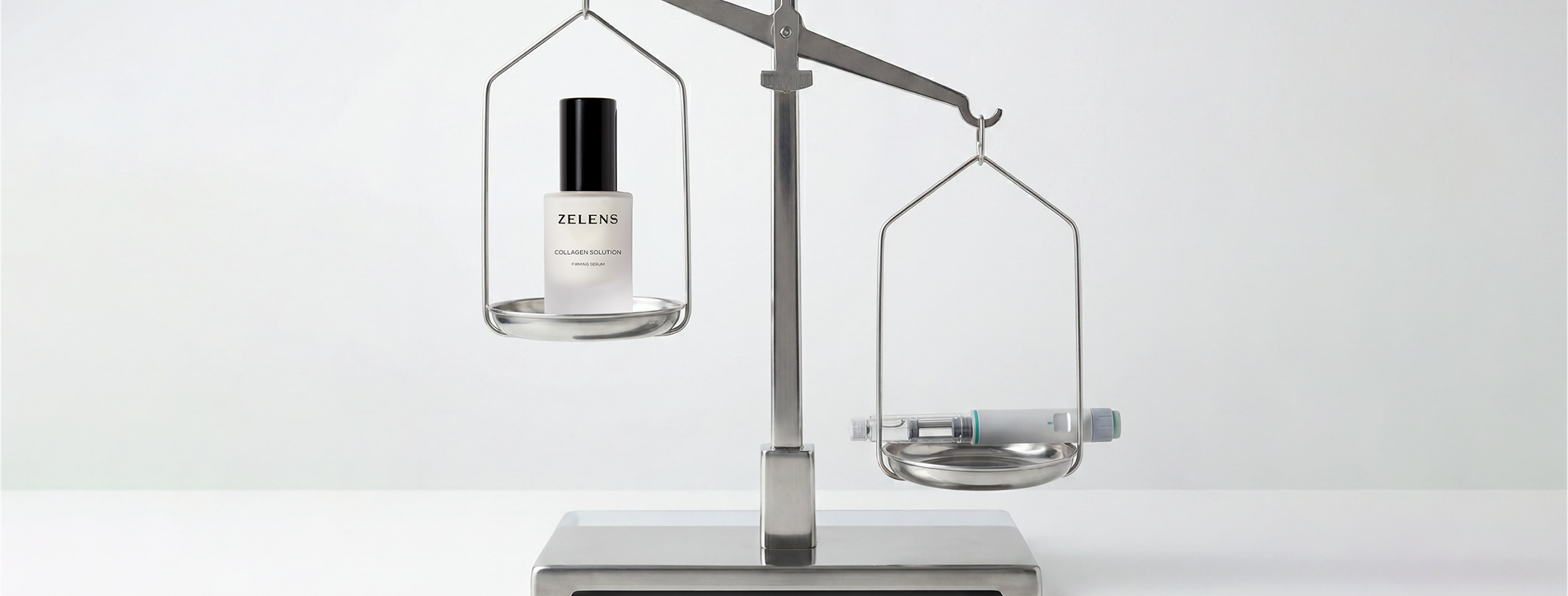
GLP-1 medications, including semaglutide and tirzepatide, have reshaped the weight-loss conversation. They are also reshaping another conversation: the one happening in dermatology clinics, where a growing number of patients are asking why their skin no longer looks as firm as it used to. The phenomenon has earned an unofficial label – “Ozempic face” - but the underlying biology is not limited to the face, and it is not limited to any single medication.
Dr Marko Lens - a plastic & reconstructive surgeon, Oxford-trained researcher, and founder of Zelens - has seen this pattern in his London clinic. This article explains the science and outlines how to help support the skin through it, including with Collagen Solution Firming Serum, his latest innovation.
Why GLP-1 affects skin, not only weight
GLP-1 receptor agonists were developed to regulate blood sugar in type 2 diabetes and, more recently, to support weight management. They work by mimicking a hormone called glucagon-like peptide-1, which slows gastric emptying and reduces appetite. The weight loss that follows is frequently significant and, compared with conventional diet and exercise, notably rapid.
The skin, however, adapts at its own pace. Collagen synthesis is a slow biological process; the dermal network that gives skin its firmness takes years to build and months to remodel. When fat is lost faster than the dermal matrix can reorganise, the supporting scaffold beneath the skin shrinks while the surface area does not. The visible result is laxity, crepiness, and a loss of the contour once held up by underlying fat pads.
This is not an effect exclusive to GLP-1 treatment. Any rapid weight loss - post-bariatric surgery, severe calorie restriction, significant illness - produces similar changes. What makes the current moment distinct is the scale at which GLP-1 medications are being prescribed, and the speed at which results arrive.
The collagen question: what the science currently suggests
Research into the dermatological effects of GLP-1 is still emerging, but the mechanisms under investigation point in a consistent direction.
1. Volume loss in the dermal fat pads
The face contains discrete compartments of subcutaneous fat that contribute to youthful contour. When overall body fat decreases quickly, these compartments deplete - and because the skin itself has not shrunk proportionately, the surface begins to drape rather than sit taut.
2. A possible effect on fibroblasts and collagen support
Published research has begun to examine whether GLP-1 receptor activity on fibroblasts may influence local collagen support pathways. Early findings suggest that the dramatic remodelling associated with rapid weight loss is not compensated for by equivalent collagen remodelling at the level of the skin - a gap that manifests as reduced firmness.
3. Muscle mass changes
Weight lost on GLP-1 therapy is not exclusively fat. A proportion is lean mass, including facial muscle, which provides further structural support beneath the skin. When facial muscles thin alongside fat depletion, the combined effect is a more sunken appearance.
In short: the skin changes associated with GLP-1 are the product of simultaneous losses - fat, support, and firmness - rather than any single cause.
“GLP-1s change more than weight. Rapid weight loss can impact collagen levels and skin firmness. Many of my patients using a GLP-1 medication for weight loss tell me they are not only losing weight, but also noticed that skin is less firm. Collagen Solution might be an option to help support collagen levels in people who are on a GLP-1 medication.” - Dr. Marko Lens
What Ozempic face actually is
Ozempic face is a colloquial term - not a medical diagnosis - for the cluster of facial changes that can follow rapid GLP-1-assisted weight loss. Commonly described features include:
- Hollowing of the temples and cheeks
- Deepening of nasolabial folds
- Laxity along the jawline and under the chin
- Thinner-looking, less cushioned skin
- More visible fine lines, particularly in the neck and around the eyes
It is worth noting that the same pattern can follow any significant rapid weight loss, which is why some practitioners prefer the broader term of post-weight-loss facial volume change. The label matters less than the recognition that skin can, and often does, respond more slowly than the weighing scale.
How to help support collagen during and after GLP-1 treatment
Skincare cannot replace fat, and no topical formula can claim to reverse structural change. What well-formulated skincare can do is help support the skin’s own collagen production and address the visible appearance of reduced firmness. A considered approach combines several habits:
Protect against collagen-degrading factors
UV exposure, smoking, and chronic inflammation all degrade existing collagen faster than the skin can produce new collagen. A broad-spectrum SPF 30 or higher every day is non-negotiable for sun protection, and anyone concerned with firmness affected by environmental factors.
Choose active ingredients that help support the skin's collagen pathways
Peptides, Vitamin C, and bio-fermented botanical actives have all been studied for their role in supporting the skin’s own collagen-producing processes. Formulation quality and combination matter - this is where a well-engineered serum earns its place in the routine.

The Collagen Solution Firming Serum
Collagen Solution Firming Serum was developed by Dr Marko Lens to help support the skin’s natural collagen production. It is formulated for face and neck - because the neck and décolleté are frequently overlooked in routines, despite being among the first areas to show collagen decline.
The CM-5S™ complex
At the heart of the formula is CM-5S™, a proprietary hyperfermented botanical complex of five Sicilian botanicals personally developed by Dr Lens:
- Pantelleria Caper, rich in flavonoids with antioxidant, anti-inflammatory and photo-protective properties
- Siccagno Tomato, rich in lycopene, an antioxidant known to help protect collagen and elastin fibres
- Red Grape skin, rich in polyphenols with antioxidant and anti-inflammatory properties
- Sicilian Manna, a tree sap extract with regenerating, moisturising and soothing properties
- Prickly Pear, which helps support barrier recovery, hydrates and soothes the skin
Independent in-vitro testing of the CM-5S™ complex has been shown to help boost Type I collagen production by over 600% in only 10 days.
Independently tested
The finished serum was put through a 28-day independent clinical trial and self-assessment study with 33 participants aged 57 to 70. Among the findings reported by participants:
- 100% agreed skin looks firmer
- 97% agreed face and neck look smoother
- 93.9% agreed they noticed improvements in jawline definition
Clinical testing also reported:
- Lifting of the jawline up to 3.71 mm
- Increase in skin firmness up to 20.9%
- Increase in skin elasticity up to 18.4%

Four benefits in a single formula
Alongside CM-5S™, the formula contains a vegan, skin-identical collagen polypeptide, amino acids, hyaluronic acid and vitamin E within a silky, lightweight emulsion base. It is designed to:
- Help support the skin's natural collagen production for visibly firmer, smoother skin
- Promote skin's natural barrier recovery
- Replenish skin's moisture
- Strengthen skin's resilience to environmental stressors through the antioxidant and anti-inflammatory properties of active molecules
As weight goes down, help collagen levels go up
For anyone on a GLP-1 medication, the case for a considered, collagen-supportive routine is straightforward. Rapid change asks more of the skin than it can easily give on its own. The right formula will not stop the process, but it can help the skin keep pace with it.
Shop Collagen Solution Firming Serum
Frequently asked questions
Do GLP-1 medications cause collagen loss?
GLP-1 medications are not currently shown to destroy collagen directly. What they cause is rapid fat loss, which can reveal and accelerate the appearance of collagen decline that was already underway. The visible effect is a reduction in skin firmness.
Is “Ozempic face” permanent?
Fat loss in the facial compartments is not automatically reversible simply by stopping the medication. Skin does remodel over time with slower weight changes, targeted skincare, and, in some cases, in-clinic treatments chosen with a qualified practitioner. Skincare alone cannot replace lost fat, but it can help support the skin’s own firmness-related processes.
Can skincare really help support collagen production?
Topical skincare cannot replace structural losses, and no cosmetic product can claim to do so. It can, however, help support the skin’s own collagen production - which is what well-formulated serums containing peptides, antioxidants and clinically tested botanical complexes are designed to do. CM-5S™, the proprietary complex in Collagen Solution Firming Serum, has been shown in independent in-vitro testing to help boost Type I collagen production by over 600% in 10 days.
When should I start using a firming serum?
Prevention is always more effective than recovery. Starting a collagen-supportive routine before or early in GLP-1 treatment gives the skin the best chance to keep pace with other changes.
The bottom line
GLP-1 medications are changing how people lose weight, and in doing so, they are prompting a broader conversation about what the skin needs during periods of rapid change. The good news is that the right combination of lifestyle, protection and well-formulated skincare can help the skin navigate both.